


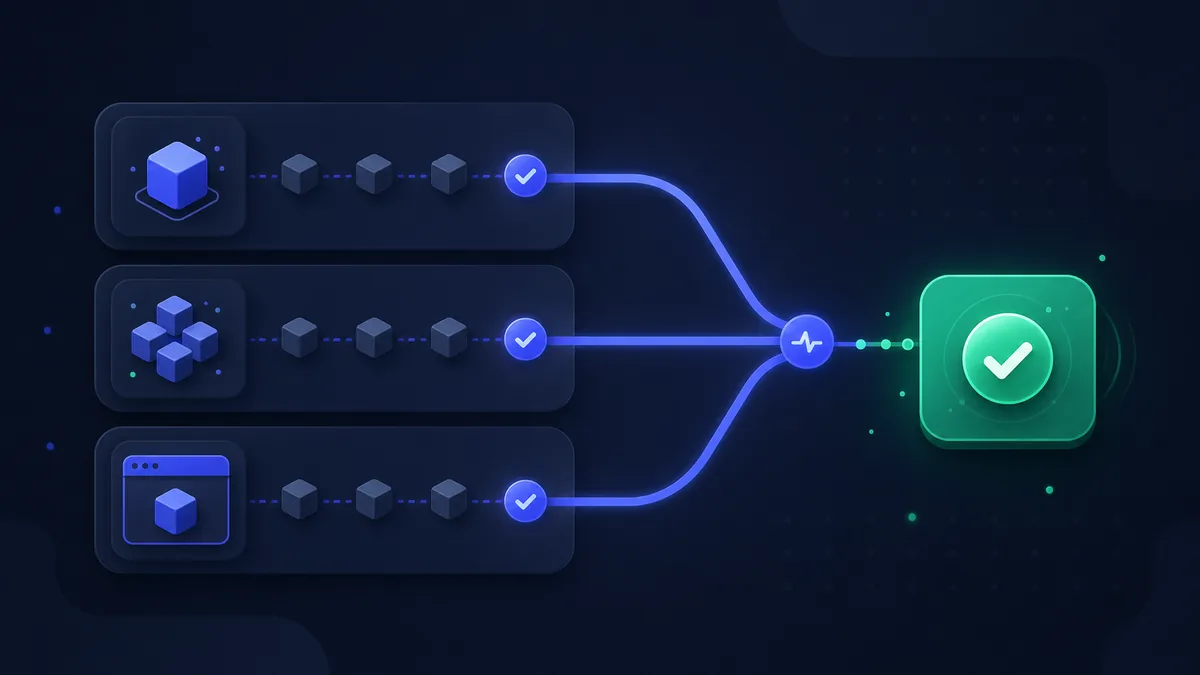
Vitest hit 14 million weekly downloads in early 2026. Two years ago, it was under 4 million. Meanwhile, Jest — still the most downloaded test runner at 32 million/week — has plateaued.
The JavaScript testing landscape has shifted. New defaults are emerging, and teams that haven't re-evaluated their testing stack are leaving performance and developer experience on the table.
We compared every major testing framework using real npm health data from PkgPulse. Here's where things stand.
The Testing Stack in 2026
Before diving into individual comparisons, here's the modern testing pyramid and where each framework fits:
| Layer | What It Tests | Recommended Framework |
|---|---|---|
| Unit | Functions, hooks, utilities | Vitest |
| Component | UI components in isolation | Vitest + Testing Library |
| Integration | Multiple modules working together | Vitest |
| E2E | Full user flows in a real browser | Playwright |
The 2026 default stack: Vitest for everything below the browser, Playwright for everything in it.
That said, "default" doesn't mean "always." Let's look at the data.
Unit Testing: Jest vs Vitest
This is the comparison most teams are evaluating right now.
| Metric | Jest | Vitest |
|---|---|---|
| Weekly Downloads | ~32M | ~14M |
| Test Execution Speed | Baseline | 3-5x faster |
| ESM Support | Experimental | Native |
| Config | jest.config.js | vite.config.ts (shared) |
| API Compatibility | — | Jest-compatible |
| TypeScript | Via transform | Native |
| Watch Mode | File-based | Module graph-based |
See the full comparison at PkgPulse
Why Vitest Is Faster
Vitest isn't just incrementally faster — the gap is structural:
- Native ESM — no transformation step for modern JavaScript
- Vite-powered — leverages Vite's module resolution and HMR pipeline
- Smart watch mode — only re-runs tests affected by the changed module, not the whole suite
- Worker-based parallelism — each test file runs in an isolated worker thread
For a 200-test suite, the difference is tangible: 8-12 seconds on Jest, 2-4 seconds on Vitest. On a 1,000-test codebase, it's the difference between running tests on every save and running them before commits.
Migration Is Painless
Vitest implements Jest's API almost entirely. In most cases, migration is:
// jest.config.js → vitest.config.ts
// Change imports:
// import { describe, it, expect } from '@jest/globals'
// to:
import { describe, it, expect } from 'vitest'

// Most test files need zero changes.
// jest.fn() → vi.fn()
// jest.mock() → vi.mock()
// jest.spyOn() → vi.spyOn()
Vitest's default output style is similar to Jest's, making the switch feel familiar.
The Verdict
New projects: Use Vitest. There's no reason to start with Jest in 2026.
Existing Jest projects: Migrate when it makes sense — a large refactor, a framework upgrade, or increasing frustration with test speed. The migration is low-risk because the APIs are compatible.
E2E Testing: Playwright vs Cypress
For browser-based testing, the landscape has consolidated around two tools.
| Metric | Playwright | Cypress |
|---|---|---|
| Weekly Downloads | ~12M | ~6M |
| Browser Support | Chromium, Firefox, WebKit | Chromium, Firefox, (WebKit experimental) |
| Parallel Execution | Built-in, per-worker | Paid (Cypress Cloud) |
| Mobile Testing | Yes (device emulation) | No |
| Language Support | JS, TS, Python, Java, C# | JS, TS only |
| Speed | Faster (direct browser protocol) | Slower (proxy-based) |
| Interactive Debugging | Trace viewer, VS Code extension | Time-travel UI (excellent) |
See the full comparison at PkgPulse
Playwright's Advantages
Playwright connects to browsers via their native debugging protocol (CDP for Chromium, equivalent for Firefox/WebKit). This gives it:
- True multi-browser testing — including Safari via WebKit, which matters for production
- Built-in parallelism — run tests across workers without paying for a cloud service
- Network interception — mock APIs at the browser level, not just at the test runner
- Mobile emulation — test responsive layouts with real device parameters
- Auto-waiting — elements are automatically waited for, reducing flaky tests
Cypress's Advantages
Cypress still leads in one critical area: interactive debugging. Its time-travel UI — where you can step through test execution and see exactly what the browser rendered at each point — is genuinely best-in-class. For teams that spend significant time debugging E2E failures, this matters.
Cypress also has a gentler learning curve. Its API reads more like natural language:
// Cypress — reads like English
cy.get('[data-testid="login-button"]').click()
cy.url().should('include', '/dashboard')

// Playwright — more explicit, more powerful
await page.getByTestId('login-button').click()
await expect(page).toHaveURL(/dashboard/)
Both are readable. Cypress is slightly more approachable for developers who don't write tests often.
The Verdict
Playwright for most teams in 2026. Multi-browser support, free parallelism, and mobile testing give it a clear practical advantage.
Cypress if interactive debugging is your team's top priority, or if your test suite is Chromium-only and your testers prefer its API style.
The download trend tells the story: Playwright has overtaken Cypress in weekly downloads and the gap is widening.
The Others: Still Relevant?
Mocha
Still used in legacy projects, but rarely chosen for new ones. Requires manual setup for assertions (Chai), mocking (Sinon), and coverage (Istanbul). The flexibility that once made Mocha attractive is now a maintenance burden.
When it still makes sense: Large projects already on Mocha with extensive custom configuration that would be costly to migrate.
Jasmine
Angular's traditional default testing framework. Jasmine is BDD-focused and comes bundled with Angular's test runner. Angular teams using the CLI will find it well-integrated.
When it still makes sense: Angular projects using the default test setup. Even here, some teams are migrating to Vitest with @analogjs/vitest-angular.
AVA
A niche choice with a loyal following. AVA runs each test file in a separate Node.js process, providing true isolation. Its minimal API is clean, but the ecosystem is small.
When it still makes sense: Projects that need strict process-level test isolation — edge cases, not the norm.
CI Integration
Testing frameworks need to integrate with CI pipelines as much as local development. Vitest and Playwright both have first-class CI support, but there are specific configurations that matter in practice.
For Vitest on GitHub Actions, the key is enabling the --reporter=github-actions flag, which formats test output as GitHub annotations. Failed tests appear as inline file annotations in the PR diff view, making failures immediately visible without reading raw logs.
# GitHub Actions — Vitest with coverage
- name: Run tests
  run: npx vitest run --coverage --reporter=github-actions
  env:
    CI: true
Playwright's CI story is more involved because it requires browser binaries. The official GitHub Action caches browser downloads between runs, which is essential for keeping CI fast:
# GitHub Actions — Playwright
- name: Install Playwright Browsers
  run: npx playwright install --with-deps chromium
- name: Run E2E Tests
  run: npx playwright test
- name: Upload test report
  if: failure()
  uses: actions/upload-artifact@v4
  with:
    name: playwright-report
    path: playwright-report/
Uploading the Playwright HTML report as an artifact on failure is essential for debugging flaky tests in CI. The trace files (set trace: 'on-first-retry' in playwright.config.ts) record every browser action and can be replayed locally with npx playwright show-trace.
Coverage in 2026
Both Vitest and Jest support V8 and Istanbul coverage providers. V8 coverage is faster (built into Node.js) but measures coverage at the JavaScript engine level. Istanbul instruments source code and is more accurate for TypeScript projects where you care about which lines of TypeScript specifically are tested.
The practical difference: V8 may report uncovered lines differently than Istanbul when TypeScript constructs compile to multiple JavaScript statements. For most teams, V8 is the better default — it's faster and the accuracy difference rarely matters.
// vitest.config.ts — coverage setup
export default defineConfig({
  test: {
    coverage: {
      provider: 'v8',
      reporter: ['text', 'lcov', 'html'],
      exclude: ['**/*.test.ts', '**/node_modules/**', '**/dist/**'],
      thresholds: {
        global: { lines: 80, functions: 80, branches: 70 },
      },
    },
  },
});
Setting coverage thresholds prevents regressions — a PR that drops line coverage below 80% fails CI. The lcov reporter generates a format compatible with Codecov, Coveralls, and similar coverage tracking services.
Framework Comparison Table
| Feature | Vitest | Jest | Playwright | Cypress | Mocha |
|---|---|---|---|---|---|
| Speed | Very fast | Moderate | Fast | Moderate | Moderate |
| Setup Time | Minutes | Minutes | Minutes | Minutes | Hours |
| ESM Support | Native | Experimental | N/A | N/A | Plugin |
| TypeScript | Native | Transform | Native | Native | Plugin |
| Browser Testing | No | No | Yes | Yes | No |
| Parallel | Built-in | Built-in | Built-in | Paid | Plugin |
| Community Size | Growing fast | Largest | Growing fast | Large | Declining |
All health scores, download trends, and bundle data available on PkgPulse: jest-vs-vitest, cypress-vs-playwright.
Our Recommendation for 2026
Starting a new project:
- Vitest for unit, component, and integration tests
- Playwright for E2E and browser tests
Existing Jest projects:
- Stay on Jest if it's working and tests are fast enough
- Migrate to Vitest when speed becomes a bottleneck or during a major upgrade
Angular teams:
- Jasmine + Karma (default) or migrate to Vitest via
@analogjs/vitest-angular - Playwright for E2E (replacing Protractor, which is deprecated)
The testing landscape is more settled than it's been in years. The tools are mature, the migration paths are clear, and the data shows where the ecosystem is heading.
Compare Jest vs Vitest on PkgPulse →
Frequently Asked Questions
Should I use Jest or Vitest in 2026?
For new projects, Vitest. It's 3-5x faster, has native ESM and TypeScript support, and shares configuration with Vite. For existing Jest projects, migration is low-risk but not urgent — migrate when speed or ESM compatibility becomes a pain point. See the full comparison on PkgPulse.
Is Playwright better than Cypress?
Playwright has overtaken Cypress in downloads and leads in multi-browser support, free parallelism, and mobile testing. Cypress retains an edge in interactive debugging UX. For most teams starting fresh, Playwright is the stronger choice. Compare them at PkgPulse.
What is the fastest JavaScript test runner?
Vitest is the fastest mainstream JavaScript test runner in 2026, typically running 3-5x faster than Jest thanks to native ESM, Vite-powered module resolution, and smart watch mode that only re-runs affected tests. Bun test is even faster but has narrower compatibility — see Bun vs Vitest vs Jest benchmarks for details.
Test Organization and Data Management
Beyond choosing a framework, how you organize test code and manage test data determines whether a test suite stays maintainable as it grows. Common patterns matter more than the framework choice.
Test File Co-location vs Centralized Test Directories
Two conventions dominate: co-locating test files alongside source files (Button.tsx + Button.test.tsx in the same directory) or centralizing them in a top-level __tests__/ or tests/ directory. Both work with all major frameworks. Co-location is the more common choice for component tests — the test file is immediately discoverable and imports are shorter. Centralized directories are common for integration and E2E tests, where the test file's location reflects the test's scope rather than proximity to implementation.
Vitest and Jest both support flexible test file patterns. The default glob (**/*.{test,spec}.{ts,js}) handles both conventions. Playwright defaults to tests/ but is configurable via testDir.
Test Data: Factories vs Fixtures
Hard-coded test data leads to brittle tests. If userProfile.json fixture defines an email as test@example.com and your validation logic later changes to reject certain email formats, multiple unrelated tests break. Test factories — functions that generate test data with sensible defaults that can be overridden per test — are more resilient:
// Test factory pattern
function createUser(overrides = {}) {
  return {
    id: 'user-1',
    name: 'Alice',
    email: 'alice@example.com',
    role: 'user',
    createdAt: new Date('2026-01-01'),
    ...overrides,
  };
}

// Tests use only the data they care about
test('admin can delete any post', () => {
  const admin = createUser({ role: 'admin' });
  expect(canDelete(admin, postId)).toBe(true);
});
Factory functions document which properties are relevant to each test and make it trivial to create variations. Libraries like @faker-js/faker provide realistic-looking fake data for factories, which catches edge cases that hard-coded values miss (Unicode names, emails with plus addressing, etc.).
Handling Async in Tests
Async testing has a common failure mode: a test resolves before the async operation completes, producing a false positive. All three frameworks handle this correctly when tests return promises or use async/await, but manual setTimeout usage can still cause issues:
Vitest's fake timers (vi.useFakeTimers()) control setTimeout, setInterval, and Date without actually waiting. This makes timer-dependent tests fast and deterministic. The key is advancing fake timers manually with vi.advanceTimersByTime(ms) or vi.runAllTimers() rather than using await new Promise(resolve => setTimeout(resolve, 1000)).
When to Use Mocks
Mocking is appropriate for external dependencies (HTTP clients, email senders, database adapters) and for isolating the unit under test from complex collaborators. It's inappropriate for testing integration between real components — mocking the very integration you're trying to verify defeats the test's purpose.
The "should I mock this?" heuristic: if the collaborator has external side effects (network call, database write, file I/O), mock it in unit tests. If the collaborator is pure logic, test it directly. Integration tests should minimize mocking to validate that components work together correctly.
Explore more testing comparisons: Jest vs Mocha, Cypress vs Playwright on PkgPulse. Related: Best JavaScript Package Managers 2026 and Best Monorepo Tools 2026.